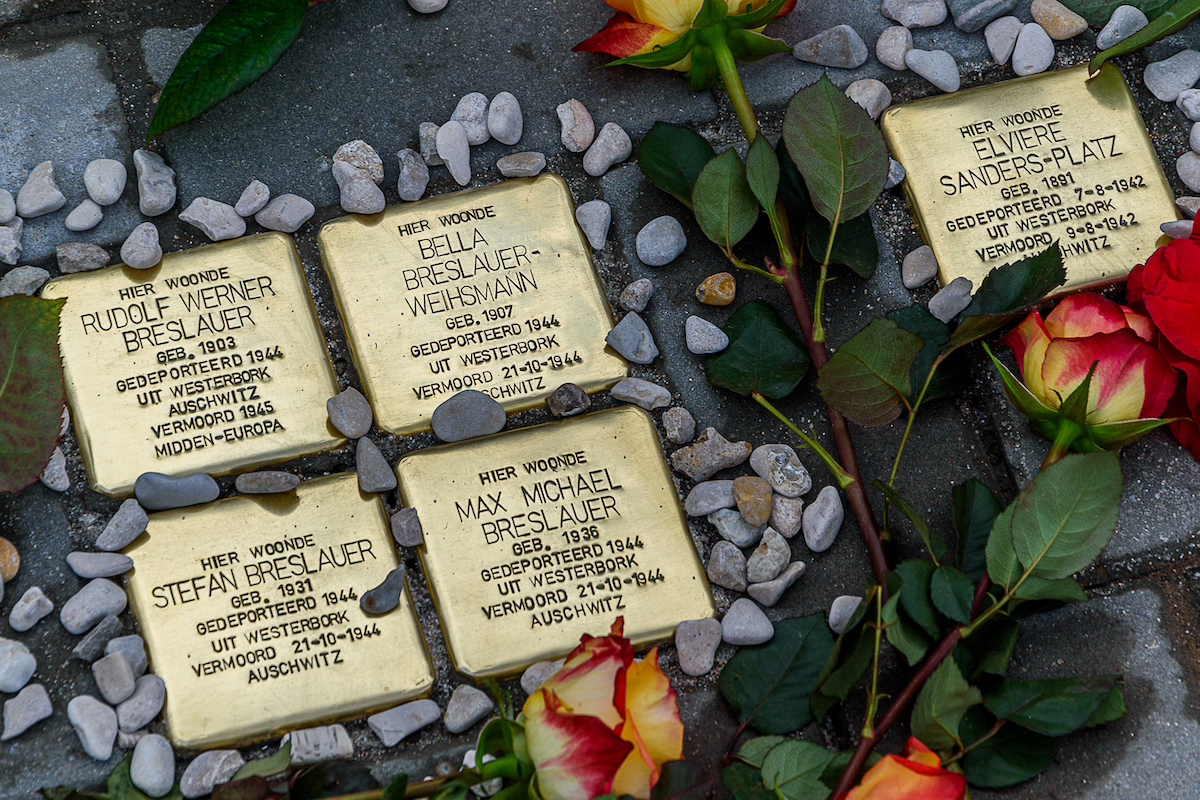
LEIDEN – In a long procession, a group of relatives and other attendees walked through Leiden’s Professorenwijk on Wednesday, March 26. Eleven new Stolpersteine – small brass memorial stones embedded in the pavement – were placed in memory of Jewish residents who were murdered during the Holocaust. The total number of Stolpersteine in the city has now surpassed one hundred.
The stones are laid at the doorsteps where lives once unfolded: children, grandparents, musicians, fathers, mothers. Passersby pause to read names, dates of birth and death, deportation details. The streets become places of remembrance.
At the Lorentz School – before the stone placement – Mayor Peter Heijkoop spoke about the importance of social connection. In times of growing uncertainty and tension, he called for increased vigilance and the forming of a protective circle around the vulnerable. “Extraordinary citizenship is already needed,” he emphasized.
Stories of loss and resilience
For many relatives, the occasion was both heavy and consoling. “I stand here not only as the granddaughter of Rudolf and Bella,” said Irit Simian from Israel, “but on behalf of all generations that followed. We are here to remember, to honor, and to keep telling their story.”
Families came from the UK, Sweden, the US, and Israel. Some had always remained in the Netherlands and now stood on the very sidewalk where their family history began. They shared stories of hope, unimaginable choices, trust that went unrewarded – and courage to go on despite it all.
The ceremony ended with the Kaddish, the Jewish prayer for the dead. Along the canal, between paving stones, stories are told. No grand marble monument, but names in brass, set at eye level with daily life. So that we continue to see – and to remember.